Klopp calls up 44 players for Germany and splits the team into two squads
- Author: Vahe Hakobyan
- Sportaran
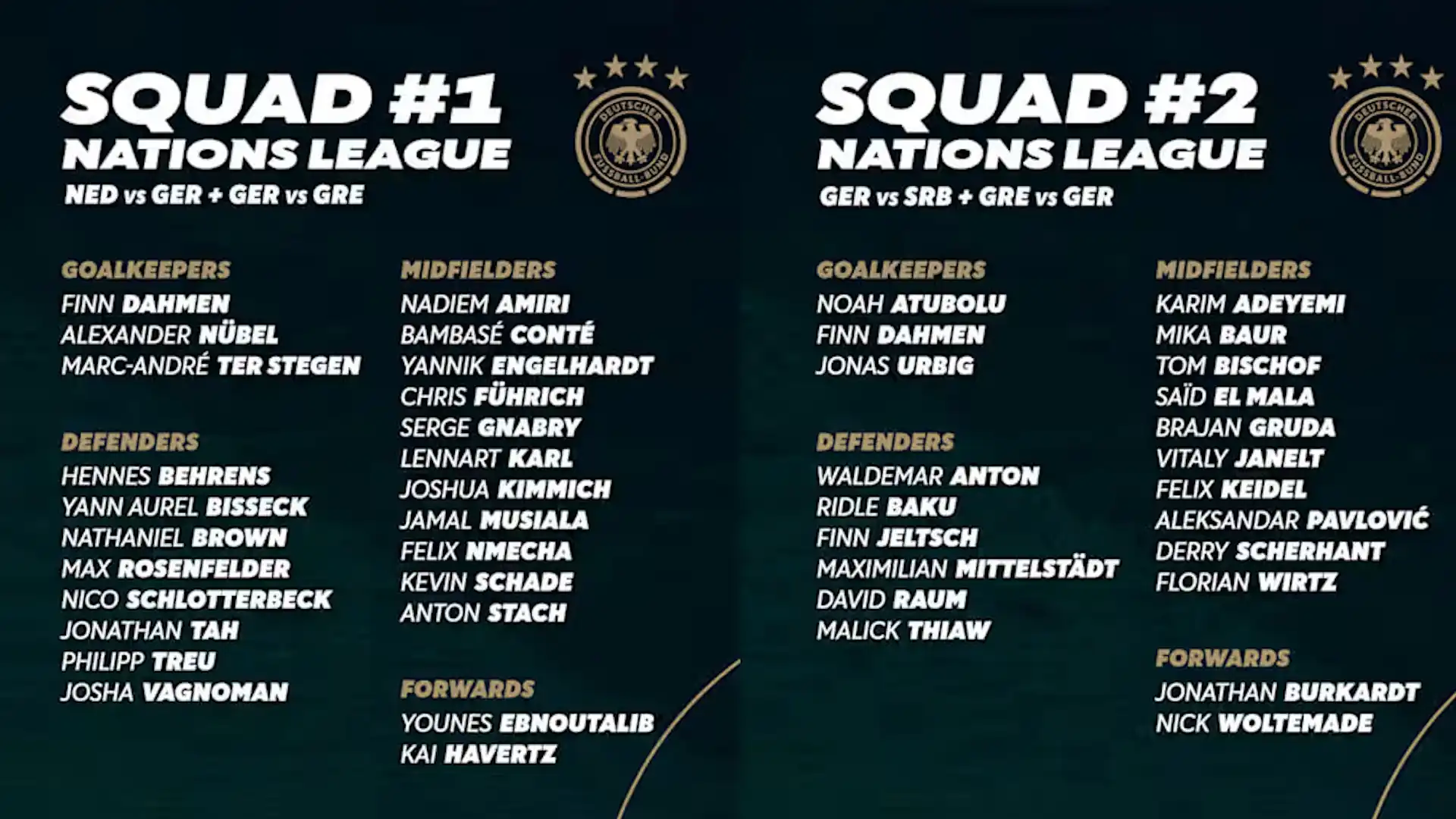
Germany head coach Jürgen Klopp has made an unusual decision ahead of the start of the UEFA Nations League. For the national team's four upcoming matches, the coach has called up as many as 44 players, dividing them into two groups.
The reason is the new congested international schedule, with Germany set to play four matches in a short period of time.
The initial group consists of 24 players. They will prepare for the first two matches:
- September 24: Netherlands vs Germany, Amsterdam
- September 27: Germany vs Greece, Augsburg
After the match against Greece, most of the players from the first group will return to their clubs, while another 20 players will join the national team.
Germany will play the second part of the international window as follows:
- October 1: Germany vs Serbia, Munich
- October 4: Greece vs Germany, Thessaloniki
However, these are not two completely separate squads. Several players from the first group will remain with the team for the second part of the camp as well. Klopp said that Nico Schlotterbeck, Jamal Musiala, Serge Gnabry and Finn Dahmen are expected to stay with the national team throughout the entire international window.
Klopp explained that the main reason for the decision is the unusual workload, as playing four international matches in such a short period has not traditionally been standard practice.
“The main reason is the four international matches in a row. Some players will still be playing for their clubs on Sunday, so the first week is very short,” Klopp explained.
In addition, Germany's new head coach wants to use the extended international camp to personally get to know a larger number of players. Klopp stressed that the split does not mean Germany have created a first-choice and a second-choice squad: the team intends to compete for victory in all four matches.
What can national teams with less squad depth do?
Germany's decision highlights another feature of an international window containing four matches. One of the strongest national teams in the world can call up 44 players, almost completely refresh its squad after two games and still maintain a very high level of quality.
For national teams with a much more limited pool of players, including Armenia, such an option is practically unavailable. Injuries, suspensions and physical fatigue affecting several key players can have a much greater impact on such teams by the third and fourth matches.
It is fortunate for Armenia that their current Nations League group does not contain a team with Germany's level of squad depth. However, the situation itself demonstrates that a four-match international window makes squad depth and the ability to rotate on a large scale even more important.
For the top national teams, this provides an additional advantage, while teams with a smaller player pool are forced to manage their players' workload much more carefully.